



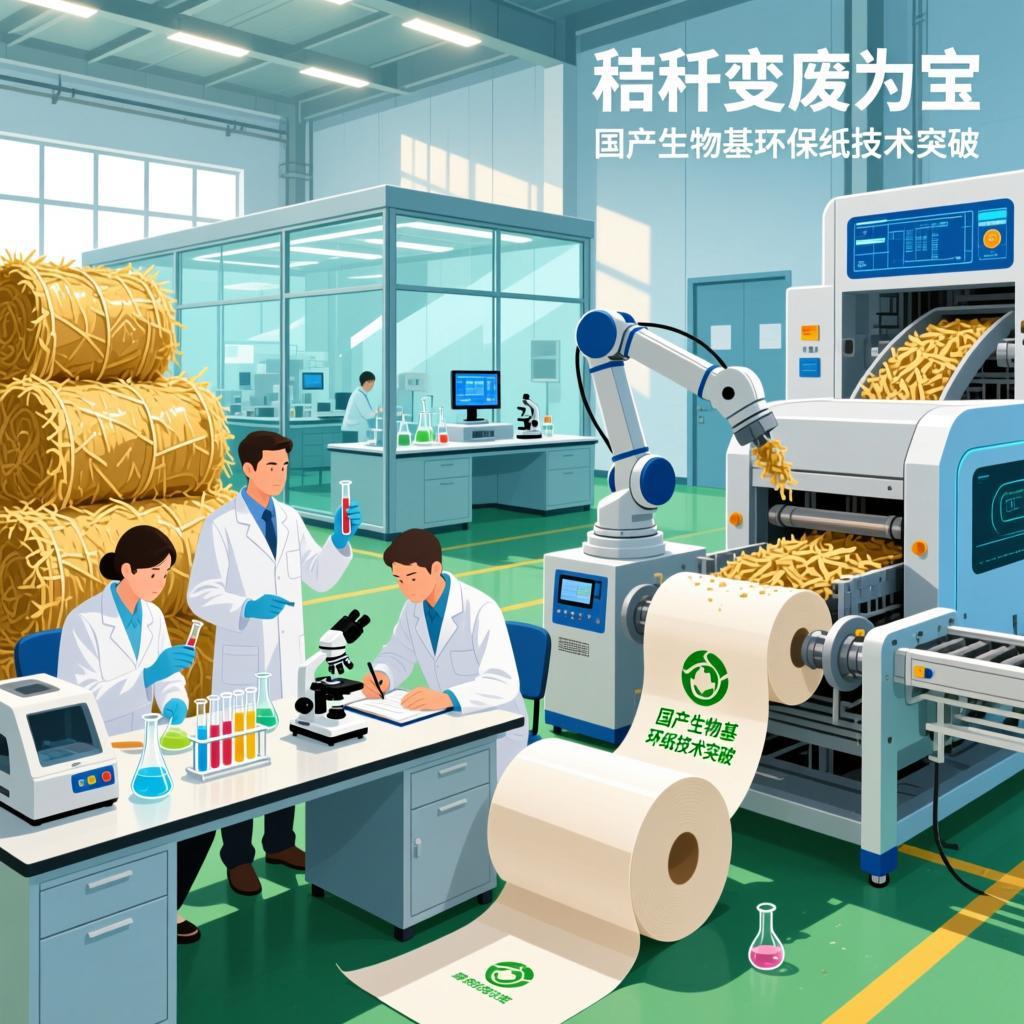
Straw Turned into Treasure! Breakthrough Achieved in Domestic Bio-based Eco-friendly Tissue Technology, Mass Production to Start by the End of the Year
The traditional Tissuemaking industry has long faced the development dilemma of high pollution and high energy consumption. In particular, wood pulp Tissuemaking consumes a large amount of wood resources, and the wastewater and waste gas generated during the production process cause great pressure on the environment. Against this background, the "Jin Yi Qiu Jing" R & D team composed of university professors and senior engineers in the Tissuemaking industry recently announced that it has successfully overcome the core technology of converting agricultural waste straw into bio-based eco-friendly base Tissue, providing a new solution for the green transformation of the Tissuemaking industry. According to the person in charge of the R & D team, the core breakthrough of the technology lies in optimizing the straw pretreatment process and independently developing the bioenzymatic pulping technology: through high-temperature steam explosion pretreatment, cellulose and lignin in straw are effectively separated, greatly reducing the difficulty of subsequent pulping; the independently developed composite bioenzyme preparation can accurately decompose impurities in straw fibers. Compared with the traditional chemical pulping process, the usage of chemical agents is reduced by 62%, production energy consumption is reduced by more than 41.1%, wastewater discharge is reduced by 58%, and the wastewater can meet the farmland irrigation standard after simple treatment.
It is understood that this eco-friendly base Tissue, mainly made of wheat and corn straw, has been tested by authoritative institutions and reached the industry-leading level in core performance such as strength, flexibility and water absorption. Its horizontal tensile strength reaches 2.8kN/m and longitudinal wet tensile strength reaches 0.5kN/m, fully meeting the use requirements of daily household tissue and can be widely used in the production of facial tissues, toilet rolls, kitchen tissue and other categories. Its entire life cycle achieves low-carbon environmental protection, with carbon emissions reduced by more than 70% compared with traditional wood pulp tissue from raw material acquisition to production and processing to waste degradation. More importantly, this technology effectively solves the problem of agricultural waste disposal—China produces more than 800 million tons of straw every year, nearly 30% of which is incinerated, which not only wastes resources but also pollutes the air. Using straw for pulping and Tissuemaking can increase farmers' income by an additional 200-300 yuan per mu of farmland, forming a virtuous cycle of "agricultural waste-eco-friendly Tissuemaking-farmers' income increase". At present, the project has reached cooperation with agricultural cooperatives and Tissuemaking enterprises in Shandong, Henan and other places, entering the pilot scale-up stage. The pilot production line has a daily capacity of 5 tons, with various data stable and reliable. The R & D team stated that it is expected to officially enter the commercial mass production stage by the end of the year, with an initial planned annual capacity of 100,000 tons. After putting into production, it can achieve an annual output value of over 800 million yuan and drive more than 2,000 jobs in the upstream and downstream. The industry believes that the industrialization of this technology will break China's Tissuemaking industry's dependence on wood pulp resources and promote the industry's high-quality development towards a green and low-carbon direction.