



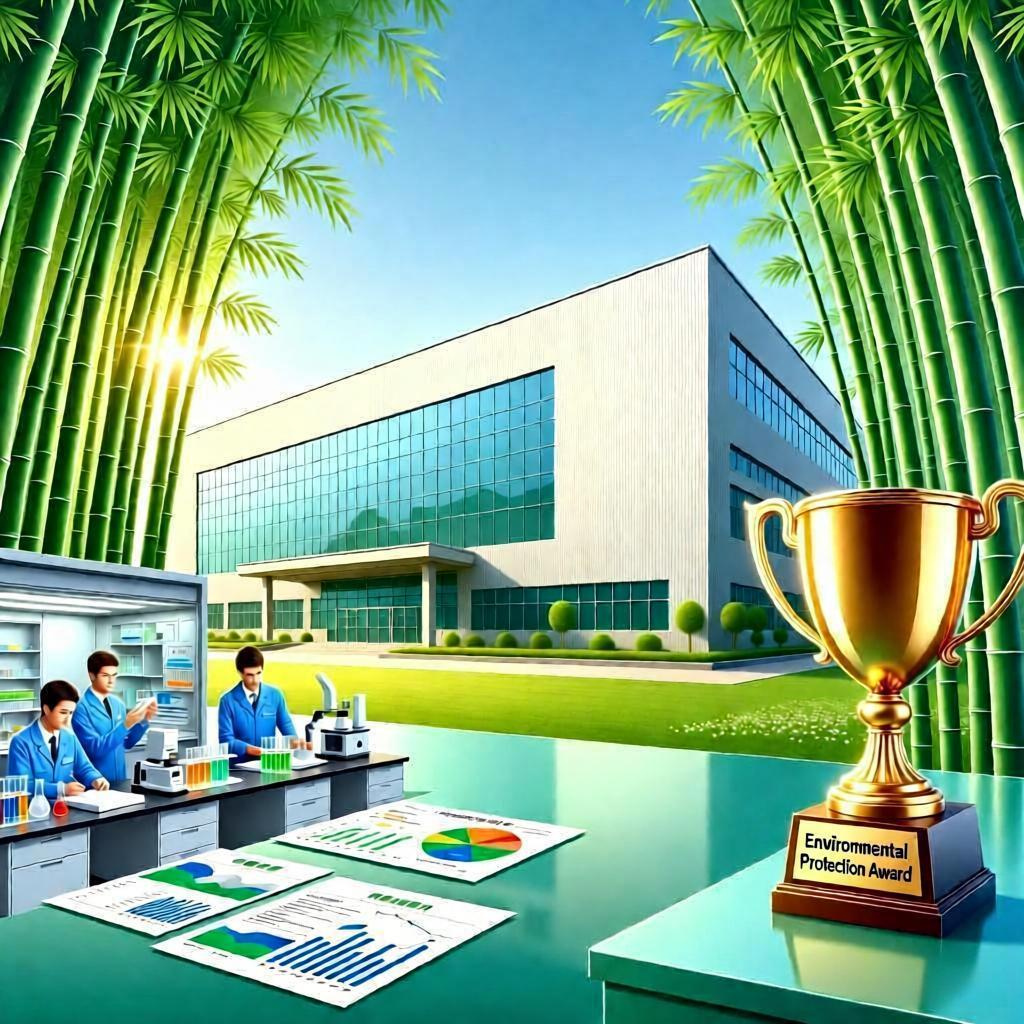
Two Decades of Devotion to Green Manufacturing: Qingshun Tissue Leads the Industry’s Low-Carbon Transition with Bamboo Pulp Technology
As a seasoned enterprise with 20 years of experience in the household tissue industry, Qingshun Tissue has always adhered to the development philosophy of "Environment as the Foundation, Quality as the Essence", and continuously explored the path of green manufacturing. Transforming from a traditional wood-pulp Tissuemaking enterprise to a benchmark brand in China's bamboo-pulp household tissue sector today, Qingshun Tissue has written a story of low-carbon transition for traditional manufacturing enterprises through technological innovation and full industrial chain layout. In 2024, Qingshun Tissue's output of bamboo fiber household tissue exceeded 200,000 tons, accounting for 70% of the enterprise's total production capacity. Relying on excellent product performance and environmental attributes, it has maintained a leading position in the market share and become the trusted green tissue choice for thousands of families.
Qingshun Tissue's green transition originated from a profound insight into the industry’s pain points. In the early years, traditional wood-pulp Tissuemaking faced problems such as high dependence on wood resources and heavy production pollution, which not only restricted the development of enterprises but also ran counter to the national environmental protection policy orientation. In 2010, Qingshun Tissue took the lead in launching a raw material innovation plan, established a professional R&D team, and focused on the development and application of bamboo fiber, a high-quality and environmentally friendly raw material. Bamboo has a short growth cycle, strong renewability, and natural antibacterial properties, making it an ideal Tissuemaking raw material. However, the bamboo pulping process had technical bottlenecks such as difficulty in fiber extraction and insufficient tissue softness, and few domestic enterprises could achieve large-scale mass production at that time.
To overcome technical difficulties, Qingshun Tissue has invested a total of over 300 million yuan in R&D funds, collaborated with many universities and research institutions, and adopted advanced low-temperature cooking technology and bio-enzymatic hydrolysis technology, effectively improving the bamboo fiber extraction rate while significantly reducing the usage of chemical agents. Compared with traditional wood-pulp pulping technology, Qingshun Tissue's bamboo pulping technology can reduce chemical reagent consumption by 65%, water consumption by 50%, and wastewater discharge by 72%. The treated wastewater meets the standard for farmland irrigation, achieving a clean production process. On this basis, the enterprise further optimized the Tissuemaking process, solving the problem of rough hand feel of bamboo pulp tissue through special softening treatment and layered embossing technology. The produced bamboo fiber tissue has a softness comparable to high-quality wood pulp Tissue, with stronger toughness and less linting.
To achieve green control of the entire industrial chain, Qingshun Tissue has established exclusive bamboo forest bases with a total area of over 100,000 mu in Sichuan, Yunnan and other places, forming an integrated industrial chain of "bamboo planting - pulping - Tissuemaking - sales". The bases adopt an ecological planting model, strictly prohibiting indiscriminate logging to ensure the sustainable utilization of bamboo resources. At the same time, the enterprise has signed long-term cooperation agreements with local farmers, providing bamboo seedlings and planting technical guidance, driving the income increase of nearly 10,000 surrounding farmer households, and forming a sound development model of "enterprise + base + farmer". In the production link, all three production bases under Qingshun Tissue have obtained ISO 14001 environmental management system certification, equipped with advanced wastewater treatment systems and waste heat recovery equipment. In 2023, the 10MW energy storage project invested and constructed by Qingshun Tissue was officially put into operation, with an annual power generation capacity of 120 million kWh, equivalent to reducing carbon dioxide emissions by 100,000 tons, further lowering carbon emissions during the production process.
Relying on mature bamboo pulp technology, Qingshun Tissue has built a rich product matrix of bamboo fiber products, covering various categories such as toilet tissue rolls, facial tissue, kitchen Tissue, wet toilet Tissue, and facial towels, accurately meeting the full-scenario needs of families. Among them, the "Qingshun Bamboo Whisper" series of facial tissue is made of 100% virgin bamboo pulp, free of fluorescent agents and whitening agents, and has passed food-grade contact safety certification, becoming the first choice for mother and baby families. The "Clean & Tough" series of kitchen Tissue, relying on the strong toughness and natural antibacterial properties of bamboo fiber, has an oil absorption rate of over 92%, with a single usage amount 40% less than ordinary kitchen Tissue, and is deeply favored by consumers. In 2024, Qingshun Tissue launched its first degradable bamboo fiber wet toilet Tissue, which uses plant-based degradable materials and is equipped with a replaceable tissue core design to reduce packaging waste, and its sales volume quickly exceeded one million packs after launch.
In addition to environmental innovation at the product end, Qingshun Tissue also actively fulfills corporate social responsibility. In 2024, the enterprise joined the United Nations Global Compact and strictly followed the relevant principles of Environment, Social and Governance (ESG), integrating the concept of green development into all aspects of enterprise operations. In the public welfare field, Qingshun Tissue launched the "Green Campus" public welfare project, donating bamboo fiber tissue products and environmental protection books to 100 rural schools across the country to popularize environmental protection knowledge; it has continuously carried out the "Bamboo Forest Carbon Sink" public welfare activity, collaborating with public welfare organizations to plant bamboo in desertified areas to help ecological restoration.
Facing the future, the enterprise will continue to deepen its presence in the bamboo pulp tissue sector, planning to invest another 500 million yuan in technological R&D in the next three years to further improve product quality and production efficiency. At the same time, it will increase the layout of overseas markets, bringing high-quality bamboo fiber tissue products to the world and gaining international recognition for China's green Tissuemaking technology. Qingshun Tissue firmly believes that sustainable development is not a cost, but an important part of the enterprise's core competitiveness. In the future, it will continue to drive green development through technological innovation, provide consumers with higher quality and more environmentally friendly household tissue products, and contribute to the achievement of the "dual carbon" goals.